
Artificial Intelligence
AI for Public Health Practice
Comprehensive resources for public health agencies: understand AI technologies, implement with a proven playbook, and apply evidence-based findings from 21 peer-reviewed studies.
Understanding AI
AI Technologies for Public Health
AI is best understood not as a single technology, but as a family of methods that make it possible to learn from large, complex data and provide timely, actionable insights.
Machine Learning
Systems that learn and improve from experience without being explicitly programmed. ML helps departments move from descriptive reporting to predictive and prescriptive analytics.
Examples: outbreak pattern detection, immunization clinic demand forecasting, follow-up appointment prediction
Natural Language Processing
Enables computers to understand, interpret, and generate human language. NLP converts unstructured text into structured data that can be analyzed and acted upon.
Examples: automated reportable condition identification, social media monitoring, multilingual chatbots, report summarization
Predictive Analytics
Uses statistical models and machine learning to estimate the likelihood of future events based on historical and real-time data — often the most accessible form of AI for health departments.
Examples: influenza forecasting, hospital occupancy prediction, heat illness risk identification
Computer Vision
Systems that interpret and analyze visual information such as photos, scans, or video. Most applications require collaboration with environmental health or academic partners.
Examples: mosquito breeding site detection from satellite imagery, housing hazard identification, telemedicine assessment support
Generative AI
AI that learns patterns from existing data to create new content — text, images, audio, or code. Generative AI produces original outputs that can be reviewed and refined by staff.
Examples: plain-language health education materials, tailored outreach messages, draft protocols and reports, synthetic datasets
Agentic AI
Systems that can analyze data, generate content, and take a sequence of actions toward a defined goal across multiple systems, following explicit rules with human oversight.
Examples: multi-step workflow coordination, information stream monitoring and classification, routine operational task automation
Responsible AI
Core Principles for Public Health AI
Equity by Design
Monitor for disparate impact on all populations. AI projects should reduce, not widen, health disparities.
Human Oversight
Humans retain final decision authority always. AI supports decision-making — it does not replace professional judgment.
Transparency
Explainable systems with auditable outputs. Communities and partners should understand how AI is being used.
Privacy and Security
HIPAA-compliant data governance and access controls. Protecting individual privacy is non-negotiable.
Continuous Monitoring
Quarterly equity audits and performance reviews ensure AI systems continue to perform as intended over time.
Community Engagement
Meaningful engagement with affected communities in the design, testing, and oversight of AI systems.
Implementation Playbook
A Practical Framework for Public Health AI Adoption
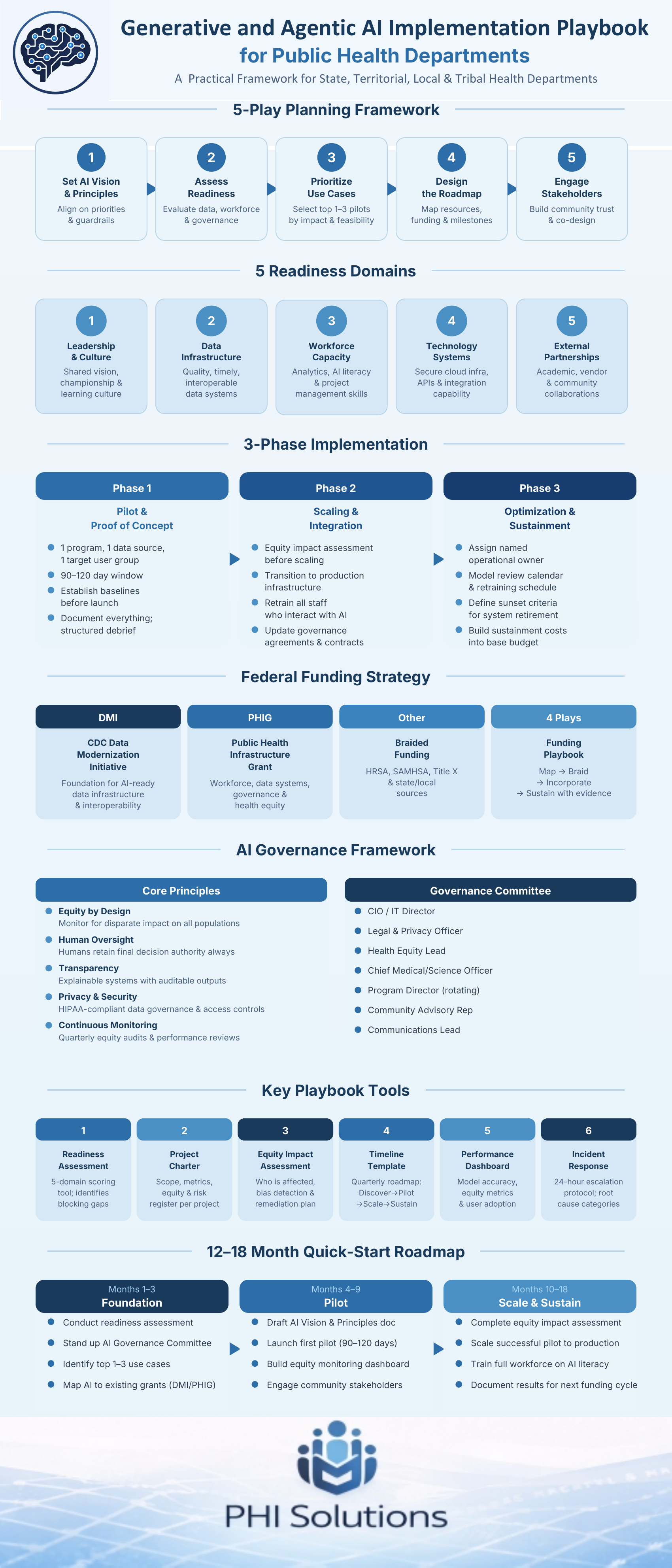
PHI Solutions developed a comprehensive planning and implementation toolkit for governmental public health agencies. The playbook is designed for state, territorial, local, and tribal health departments.
8-Play Implementation Model
Plan
Set Direction
- 1 Vision and Guardrails
- 2 Readiness Assessment
- 3 Use Case Prioritization
- 4 Implementation Roadmap
Build
Execute and Engage
- 5 Stakeholder Engagement
- 6 Funding Alignment
- 7 Change Management
Govern
Monitor and Sustain
- 8 Monitoring and Evaluation
Phased Approach
3-Phase Implementation
Phase 1: Pilot
Start small and focused to build confidence and evidence.
- 1 program, 1 data source, 1 target user group
- 90–120 day window
- Establish baselines before launch
- Document everything with structured debrief
Phase 2: Scale
Expand successful pilots with enhanced safeguards.
- Equity impact assessment before scaling
- Transition to production infrastructure
- Retrain all staff who interact with AI
- Update governance agreements and contracts
Phase 3: Sustain
Build for long-term operational success.
- Assign named operational owner
- Model review calendar and retraining schedule
- Define sunset criteria for system retirement
- Build sustainment costs into base budget
Practical Tools
Playbook Tools and Checklists
Ready-to-use templates, scoring frameworks, and checklists to support each play.
AI Readiness Self-Assessment
5-domain scoring tool for leadership, data, workforce, technology, and partnerships.
AI Project Charter
Defines scope, metrics, equity considerations, and risk register.
Equity Impact Assessment
Checklist for evaluating who is affected, bias detection, and remediation planning.
Implementation Timeline
Quarterly roadmap covering Discover, Pilot, Scale, and Sustain phases.
Change Management Plan
Communication, training, and adoption support framework.
Performance Dashboard
Model accuracy, equity metrics, user adoption tracking.
Incident Response Checklist
24-hour escalation protocol with root cause analysis categories.
Funding Strategy Checklists
Federal grant alignment, budget planning, and sustainability planning.
Data Quality Assessment
Evaluation of completeness, timeliness, accuracy, consistency, and bias.
Vendor Evaluation Checklist
Framework for evaluating AI vendors against public health requirements.
Community Engagement Tool
Planning framework for meaningful community participation in AI oversight.
Visual Overview
Playbook Framework at a Glance
Funding Guidance
Federal Funding Strategy
Guidance for aligning AI initiatives with existing federal funding streams.
CDC Data Modernization Initiative
Foundation for AI-ready data infrastructure and interoperability. Treat AI as a capability layer on top of DMI investments.
Public Health Infrastructure Grant
Broad, flexible funding for workforce, data systems, governance, and health equity — all critical prerequisites for responsible AI.
Braided Funding Approach
Combine HRSA, SAMHSA, Title X, and state/local sources using a 4-play funding strategy: Map, Braid, Incorporate, and Sustain.
White Paper — March 2026
Generative and Agentic AI in U.S. Governmental Public Health
Applications, evidence, and implementation guidance based on a systematic review of 21 peer-reviewed studies.
Key Findings at a Glance
- 72–80% reduction in surveillance chart review time using GPT-4o
- 6-day median lead-time advantage in outbreak detection with AI-guided inspection
- AI-generated vaccination messages rated significantly more effective than CDC-authored messages (p < 0.001)
- 288-million-node synthetic population model quantified vaccine hesitancy impact across 50 states
- 89.2% source citation accuracy for AI-assisted regulatory document search
This white paper synthesizes the current evidence base for generative and agentic AI applications in U.S. governmental public health. Drawing on 21 peer-reviewed studies and technical reports published between 2020 and early 2026, it provides state, territorial, local, and tribal (STLT) public health agencies with an evidence-grounded assessment of what these technologies can do, what they cannot, and how to implement them responsibly.
The evidence demonstrates measurable benefits across six application domains: public health messaging, disease surveillance, epidemic modeling, health equity analysis, community-engaged and tribal health AI, and regulatory and administrative functions.
Evidence Domains
Use Case Prioritization: Six Domains
Public Health Messaging and Communication
GPT-3-generated COVID-19 vaccination messages were rated as having significantly stronger arguments than CDC-authored messages (p < 0.001). Across 42 U.S. counties, an AI system produced messages six times more likely to be posted by county-level agencies. A critical "source label" effect was found: use AI to draft messages, review through standard workflows, and attribute to the agency.
Disease Surveillance and Outbreak Detection
The VA's GPT-4o deployment achieved 100% specificity and 82% sensitivity while reducing per-chart review time by 72–80%. For foodborne pathogen risk, AI-guided approaches captured 1.8x more critical violations with a 6-day median lead-time advantage. The CDC's SGMC pipeline curated metadata for 2.3 million genomic accessions at 94.8% accuracy.
Epidemic Modeling and Pandemic Preparedness
The EpiHiper national-scale model (288-million-node synthetic population, 50 states, 3,300 counties) quantified vaccine hesitancy impact: faster vaccination averted 6.7 million infections and 39,400 deaths. Generative AI models consistently delivered the most accurate short-term predictions across four countries.
Health Equity and Environmental Health
MortalityMinder (open-source, GitHub) integrates 70+ social/economic factors with GPT-4, producing 636 unique infographics. A GeoAI pipeline using NASA foundation models produced hourly 10–30m resolution heat maps, capturing nocturnal heat retention in underserved neighborhoods.
Community-Engaged and Tribal Health AI
The Alaska Tribal Health System developed a community-engaged AI/ML framework using community-based participatory research for medevac utilization optimization. AI deployment must begin with community governance, not technology selection.
Regulatory and Administrative Applications
GPT-4 Turbo with RAG achieved 89.2% source citation accuracy for FDA guidance documents. State-level applications include California's AI for outbreak management, Texas's ML for Medicaid fraud detection, and Massachusetts's opioid overdose prevention system.
Evidence-Based Sequencing
Three-Tier Implementation Roadmap
Sequence AI investments from lower-resource, higher-certainty applications to more complex systems.
Start Now
- LLM-assisted health communication drafting (p < 0.001 effectiveness)
- Open-source health equity analysis (MortalityMinder)
- AI-assisted regulatory document search (89.2% citation accuracy)
- LLM-assisted code generation for epidemiological modeling
Plan and Build
- Surveillance chart review augmentation (72–80% time reduction)
- Foodborne risk prediction and inspection scheduling (1.8x detection lift)
- Synthetic population generation for preparedness (r = 0.75)
- GeoAI environmental health and heat risk mapping
Invest and Partner
- National agent-based epidemic models (requires HPC)
- Genomic metadata curation at scale (2.3M+ accessions)
- Full agentic surveillance workflows
- Community-engaged AI in tribal or underserved settings
Performance Monitoring
Evidence-Based Benchmarks
| Performance Domain | Evidence-Based Benchmark |
|---|---|
| Surveillance chart review efficiency | Target: 70%+ reduction. Benchmark: 72–80% achieved (VA GPT-4o) |
| Infection classification specificity | Target: ≥95%. Benchmark: 100% achieved (VA GPT-4o) |
| Message effectiveness | Target: At least as effective as manual. Benchmark: Significantly more effective (p < 0.001) |
| Document search accuracy | Target: ≥85% correct citation. Benchmark: 89.2% (GPT-4 Turbo + RAG) |
| Outbreak detection lead time | Target: ≥5-day advantage. Benchmark: 6-day median (foodborne AI targeting) |
| Equity: model disparity | No significant accuracy difference across demographic subgroups before deployment |
| Staff time reallocation | Document proportion of time redirected to higher-complexity work within 6 months |
Cross-Cutting Considerations
Essential Principles for Implementation
Human Oversight Is Non-Negotiable
AI systems require human adjudication for consequential decisions. This is a design requirement rooted in public health accountability. GPT-4o misclassified infection timing in 7 of 50 cases; GPT-4 Turbo produced incorrect regulatory information in 13.4% of responses.
Data Quality Precedes AI
Every AI application is constrained by data quality. The highest-leverage pre-AI investment is improving data quality, standardization, and integration in foundational data systems.
Equity Cannot Be Retrofitted
Models trained on non-representative data systematically underperform for underrepresented communities. Representative data collection, community engagement, and equity impact assessment must come first.
Open-Source Lowers Barriers
Resource-constrained agencies can leverage MortalityMinder, SGMC pipeline, Von Hoene synthetic population code, EpiHiper, and public data sources (BRFSS, NHIS, PLACES, NCBI SRA) without proprietary infrastructure.
Funding AI Use Cases Through Existing Grants
| Funding Mechanism | Evidence-Aligned AI Applications |
|---|---|
| CDC PHEP | Epidemic modeling, synthetic population generation for surge planning |
| CDC OSTLTS | Surveillance modernization, LLM-assisted chart review, genomic metadata curation |
| HRSA | Health equity analysis (MortalityMinder, GeoAI heat risk mapping) |
| SAMHSA | Agentic AI for opioid overdose early identification and intervention |
| ACF / Tribal Health | Community-engaged AI governance (ATHS CBPR framework) |
| USDA / Food Safety | Foodborne pathogen risk prediction and AI-guided inspection targeting |